
The global e-learning market has grown rapidly over the past decade—driven by digital adoption, remote work, and continuous upskilling needs. Yet, while many e-learning companies succeed in launching strong products, far fewer manage to scale sustainably.
The difference rarely lies in content quality or platform features alone.
It lies in go-to-market (GTM) strategy.
At GreyRadius Consulting, we see a consistent pattern:
e-learning companies stall not because demand is absent, but because their route to market, positioning, and execution model are misaligned with how buyers actually purchase and adopt learning solutions.
This article explores how e-learning companies can design a scalable, defensible go-to-market strategy—and what separates high-growth leaders from those that plateau.
The GTM Challenge in the E-Learning Market
E-learning is often perceived as a high-growth, low-friction industry. In reality, it is one of the most crowded and competitive digital markets, spanning:
-Enterprise learning platforms
-Corporate upskilling and reskilling solutions
-Compliance and regulatory training
-Professional certification and continuing education
-B2B and B2B2C learning models
As the market matures, buyers are becoming more discerning. Decision-makers now ask:
-How does this improve workforce performance?
-What measurable business outcomes does it deliver?
-How easily can it scale across geographies, roles, and functions?
A strong go-to-market strategy for e-learning companies must answer these questions clearly and consistently.
1. Defining the Right Market Before Chasing Scale
One of the most common GTM mistakes in e-learning is trying to serve too many segments too early.
E-learning buyers differ significantly across:
-Enterprise vs SMB
-HR vs business leadership
-Regulated vs non-regulated industries
-Skill development vs compliance vs performance enablement
High-growth e-learning companies are precise about:
-Who they serve
-Which problems they solve best
-Where they can win repeatedly
From a market entry and expansion perspective, this requires:
-Clear ICP (Ideal Customer Profile) definition
-Prioritization of high-value use cases
-Alignment between product depth and buyer maturity
A focused GTM strategy allows e-learning companies to scale faster by winning narrowly before expanding broadly.
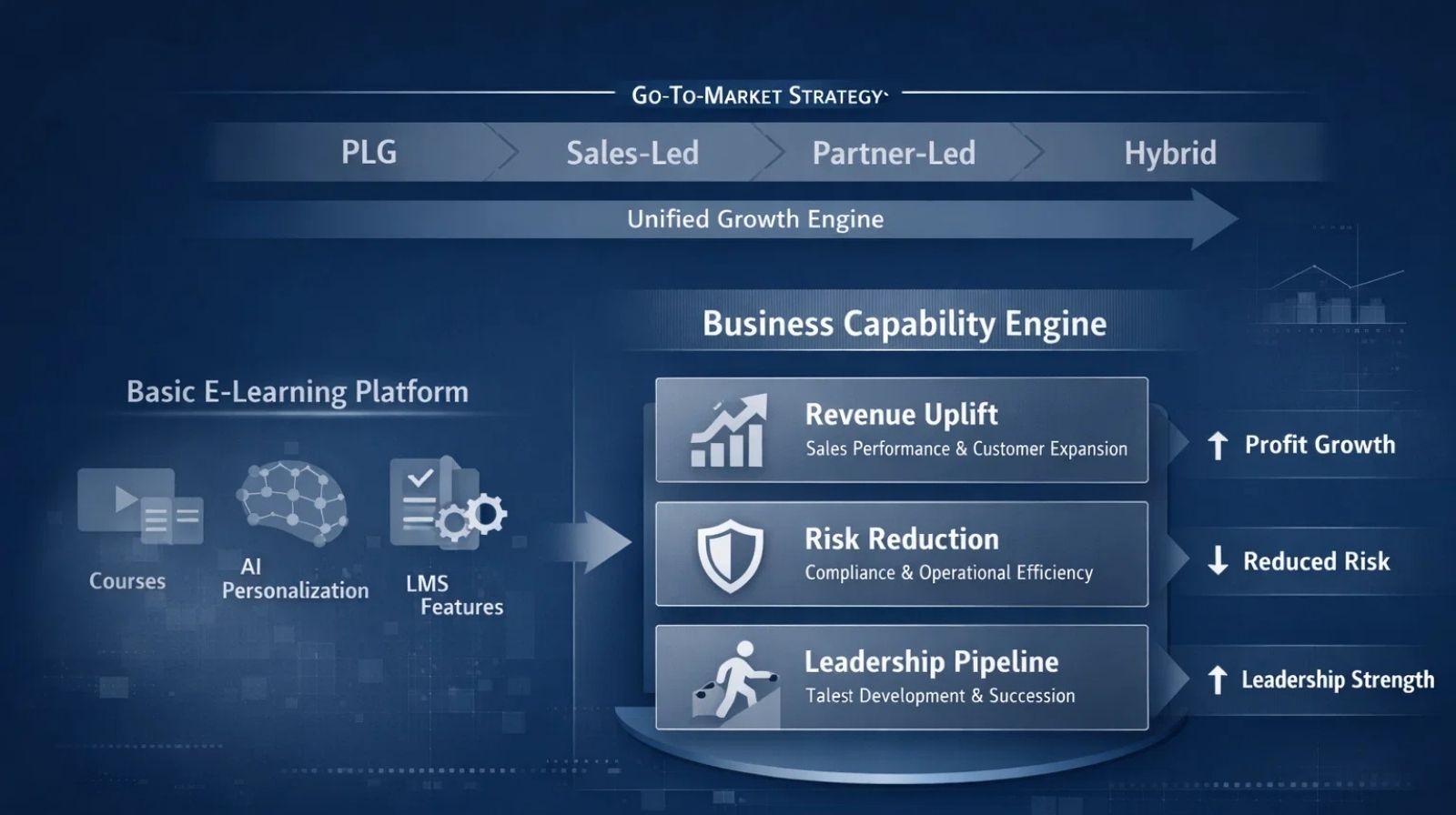
2. Positioning Beyond “Content” and “Technology”
Many e-learning companies position themselves around:
-Course libraries
-AI-powered personalization
-LMS or platform features
While important, these rarely differentiate at scale.
Successful e-learning go-to-market strategies reposition the offering as a business capability enabler, not a learning tool.
Effective positioning answers:
-What business problem does this solve?
-Whose KPIs improve as a result?
-How is success measured?
For example:
-Sales enablement platforms positioned around revenue uplift
-Compliance training tied to risk reduction and audit readiness
-Leadership development linked to bench strength and succession planning
This shift in positioning directly impacts:
-Buyer engagement
-Sales cycle length
-Willingness to pay
Strong positioning turns learning from a cost center conversation into a strategic investment discussion.
3. Choosing the Right Go-to-Market Model
There is no single GTM model that works for all e-learning companies. The right choice depends on deal size, buyer complexity, and adoption depth.
Common GTM models include:
-Product-led growth (PLG) for SMB or individual learners
-Sales-led enterprise motion for complex, multi-stakeholder deals
-Partner-led or channel-driven models for geographic or industry expansion
-Hybrid GTM models combining self-serve and enterprise sales
Scaling challenges often arise when:
-PLG models attempt to move upmarket without sales readiness
-Enterprise sales models lack clear ROI narratives
-Partner strategies are launched without enablement and governance
A robust e-learning GTM strategy aligns:
-Product packaging
-Pricing and contracting
-Sales enablement
-Customer onboarding and success
This alignment is essential to avoid growth stall as the company scales.
4. Pricing and Packaging for Scale
Pricing is one of the most underestimated levers in e-learning growth strategy.
Common challenges include:
-Over-reliance on per-user pricing without value anchors
-Discount-driven sales to close enterprise deals
-Misalignment between pricing tiers and buyer usage patterns
High-growth e-learning companies rethink pricing around:
-Value delivered (outcomes, compliance, productivity)
-Usage intensity and scale
-Organizational adoption, not just licenses
Well-designed pricing and packaging:
-Improves deal velocity
-Protects margins during scale
-Simplifies cross-sell and upsell
From a GTM perspective, pricing should reinforce—not undermine—the strategic value proposition.
5. Sales Enablement and Buyer Education
E-learning sales cycles often stall because buyers struggle to:
-Quantify ROI
-Secure internal buy-in
-Justify budget allocation
A strong go-to-market strategy invests heavily in sales enablement and buyer education.
This includes:
-Clear value narratives by persona (HR, business leaders, compliance heads)
-Use-case-driven demos
-Business impact case studies
-Outcome-oriented pilot frameworks
Rather than overselling features, scalable e-learning companies focus on:
-Proof of impact
-Referenceable success
-Structured adoption journeys
This approach shortens sales cycles and improves conversion quality.
6. Scaling Through Customer Success, Not Just Acquisition
Many e-learning companies focus heavily on customer acquisition while underinvesting in post-sale success.
In reality:
-Adoption determines renewal
-Renewal determines scalability
-Expansion determines long-term growth
A mature e-learning GTM strategy integrates:
-Structured onboarding
-Role-based learning pathways
-Usage analytics tied to outcomes
-Continuous value reinforcement
Customer success becomes a growth engine, not a support function.
This is especially critical in enterprise and regulated environments, where churn is costly and reputation matters.
7. From Growth to Repeatability
The ultimate test of a go-to-market strategy is not growth alone—it is repeatable growth.
E-learning companies that scale successfully have:
-A clearly defined ICP and buyer journey
-Consistent positioning across markets
-Predictable sales and onboarding processes
-Data-driven insights into adoption and impact
Those that stall often rely on:
-Founder-led sales
-Custom deals and exceptions
-Fragmented messaging
-Reactive growth decisions
Moving from opportunistic wins to systematic scale is the defining inflection point.
Conclusion
The e-learning market will continue to expand—but not all companies will scale with it.
In an increasingly competitive environment, go-to-market strategy becomes the primary growth differentiator, not content volume or platform features.
For e-learning companies aiming to move from early traction to sustained scale, success depends on:
-Strategic focus
-Clear positioning
-Aligned GTM execution
-Relentless attention to business outcomes

At GreyRadius Consulting, we work with e-learning and digital education companies to design scalable go-to-market strategies—grounded in market reality, buyer behavior, and execution discipline.
Because in e-learning, as in every growth market, scale is engineered—not accidental.