Context
An international manufacturer evaluating production expansion across India, Vietnam, and Indonesia faced a familiar investment question: which location could deliver the most competitive manufacturing cost while reducing dependence on its existing supply chain?
The initial logic favoured markets offering lower labour costs, attractive industrial investment conditions, and access to regional export networks. On paper, these factors could make one country appear more competitive than another.
But a manufacturing base does not operate on labour economics alone.
A location with cheaper workers could still depend heavily on imported components, face inconsistent supplier quality, or require longer inventory cycles to protect production continuity. These costs might remain largely invisible during initial country screening but become material once production volumes increased.
The investment risk was not simply choosing the wrong country. It was committing capital to a manufacturing location whose economics would deteriorate as operations scaled.
The Core Challenge
The surface problem was identifying the most cost-competitive country for manufacturing expansion.
The structural issue was that country-level cost comparisons did not reflect the operating dependencies required to manufacture, deliver, and scale a specific product.
A country could offer competitive wages without having suppliers capable of meeting the manufacturer's technical specifications, quality requirements, or production volumes. Missing inputs would need to be imported, introducing additional freight costs, customs exposure, longer replenishment cycles, and greater working-capital requirements.
This created a disconnect between the investment case and operating reality.
Finance could favour a location based on unit production costs. Procurement could identify supplier capability gaps. Operations could question power reliability and production continuity. Commercial teams could see different economics once finished goods reached their destination markets.
Each function could be correct within its own assumptions while the overall investment decision remained commercially weak.
The underlying problem was fragmented visibility into the full manufacturing economics of each location.
Without a common decision framework, leadership risked selecting a location that appeared inexpensive at commissioning but became costly to operate, expand, and serve customers from.
The Decision Shift
The company needed to stop asking where manufacturing was cheapest and start asking where the complete production ecosystem could deliver the most competitive product to the customer.
This reframed location selection from a country-ranking exercise into a product-specific investment decision.
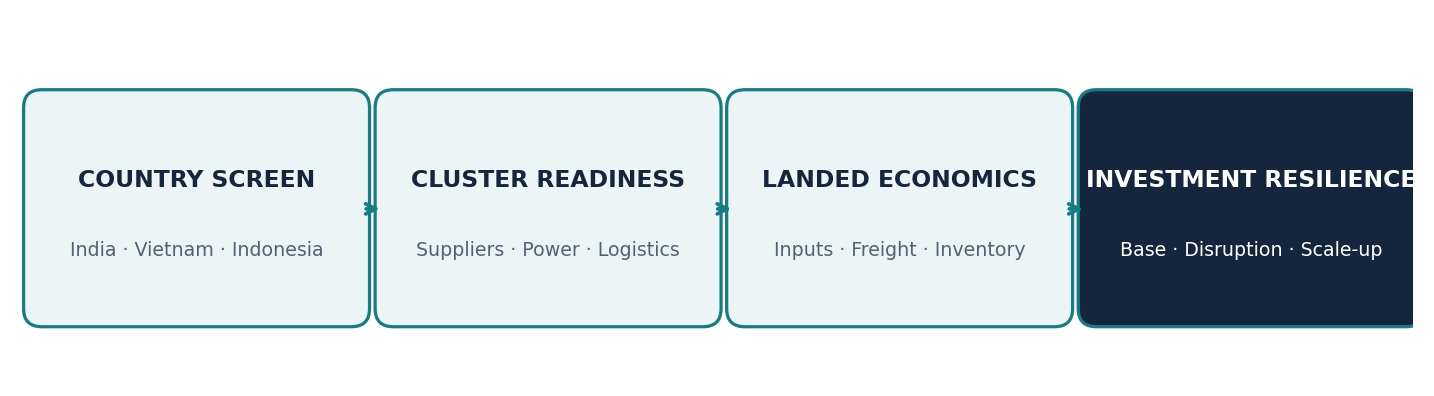
India, Vietnam, and Indonesia were no longer simply alternative labour markets. They represented different combinations of supplier ecosystems, industrial clusters, import dependencies, logistics networks, workforce capabilities, and access to customers.
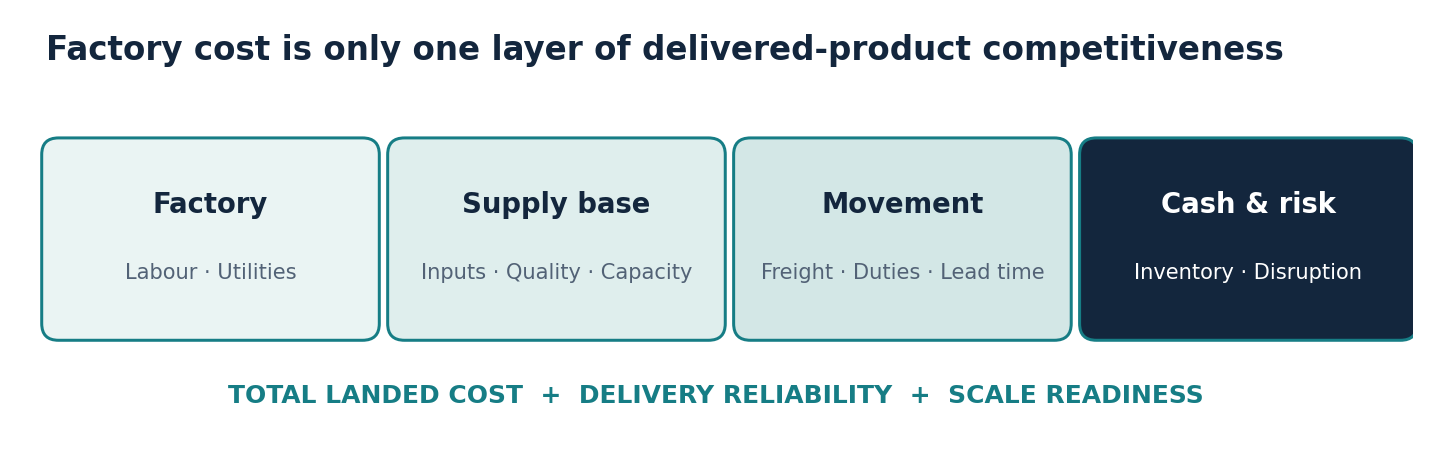
The relevant comparison was not average manufacturing cost at the national level. It was the economics of producing a defined product within a specific industrial cluster and delivering it reliably to its intended market.
A higher-cost location could become the stronger investment if local suppliers reduced imported input requirements, shortened replenishment cycles, and supported more predictable production.
Equally, an attractive initial cost advantage could disappear when additional inventory, logistics disruption, or expansion requirements entered the equation.
The decision shifted from minimising factory cost to protecting delivered-product competitiveness across the investment lifecycle.
What Changed in Execution
The first change was the unit of decision-making. Country attractiveness remained useful for initial screening, but investment viability depended on the industrial cluster and site. Supplier proximity, infrastructure reliability, logistics access, and expansion capacity became decisive considerations rather than secondary checks.
The second change was economic accountability. Labour costs could no longer determine the preferred location independently of procurement, operations, logistics, and finance. The investment case needed to reflect imported inputs, duties, freight, utilities, inventory exposure, and working capital alongside direct production costs.
Supplier availability also stopped being treated as equivalent to supplier readiness. The critical distinction was whether local suppliers could consistently meet specifications, deliver required volumes, maintain quality, and support future capacity increases.
This exposed an important scaling dependency: a factory could increase output faster than its surrounding supplier ecosystem could support it.
Finally, location competitiveness became a scenario-dependent judgment rather than a single forecast. Base-case economics needed to be considered alongside logistics disruption and production scale-up conditions.
The resulting decision logic placed greater emphasis on execution visibility, cross-functional ownership of assumptions, and the resilience of the manufacturing model before capital commitment.
Business Impact Delivered
The principal value of the reframed decision was a more defensible basis for evaluating manufacturing investment.
Rather than allowing low labour costs to dominate the business case, leadership could distinguish genuine structural cost advantages from savings that depended on favourable logistics, imported inputs, or uninterrupted supply.
Supplier dependency became an explicit investment consideration. This improved visibility into where local sourcing could support scale and where imported components might create continuing cost and continuity risks.
The approach also strengthened capital allocation discipline. Potential locations could be compared against their ability to support production economics, customer delivery requirements, and future expansion–not simply their attractiveness at initial investment.
For leadership, the commercial benefit was greater clarity over which assumptions could undermine the investment case as volumes increased.
These are decision-quality and risk-visibility benefits. The available project inputs do not establish realised savings, an implemented site selection, or quantified operating improvements.
Key Outcomes
- Three countries evaluated: India, Vietnam, and Indonesia formed the comparative screening scope.
- Three investment scenarios defined: Base-case operations, logistics disruption, and production scale-up.
- 5–7-year evaluation horizon: An illustrative period for assessing investment economics and scalability, not a confirmed project assumption.
- Stronger decision criteria: Supplier readiness, import dependence, total landed cost, infrastructure reliability, and export-market access.
- Clearer investment risk visibility: Greater emphasis on costs and dependencies that could emerge after production commencement.
The selected location, actual cost differentials, supplier assessments, and financial returns were not provided, so no quantified investment outcome is claimed.
A factory can be inexpensive to establish and expensive to depend on. The real advantage in manufacturing expansion comes from choosing an ecosystem that remains competitive when production scales, supply chains are disrupted, and customers expect consistent delivery.
Read the related manufacturing guide, or contact GreyRadius to discuss your execution priorities.